
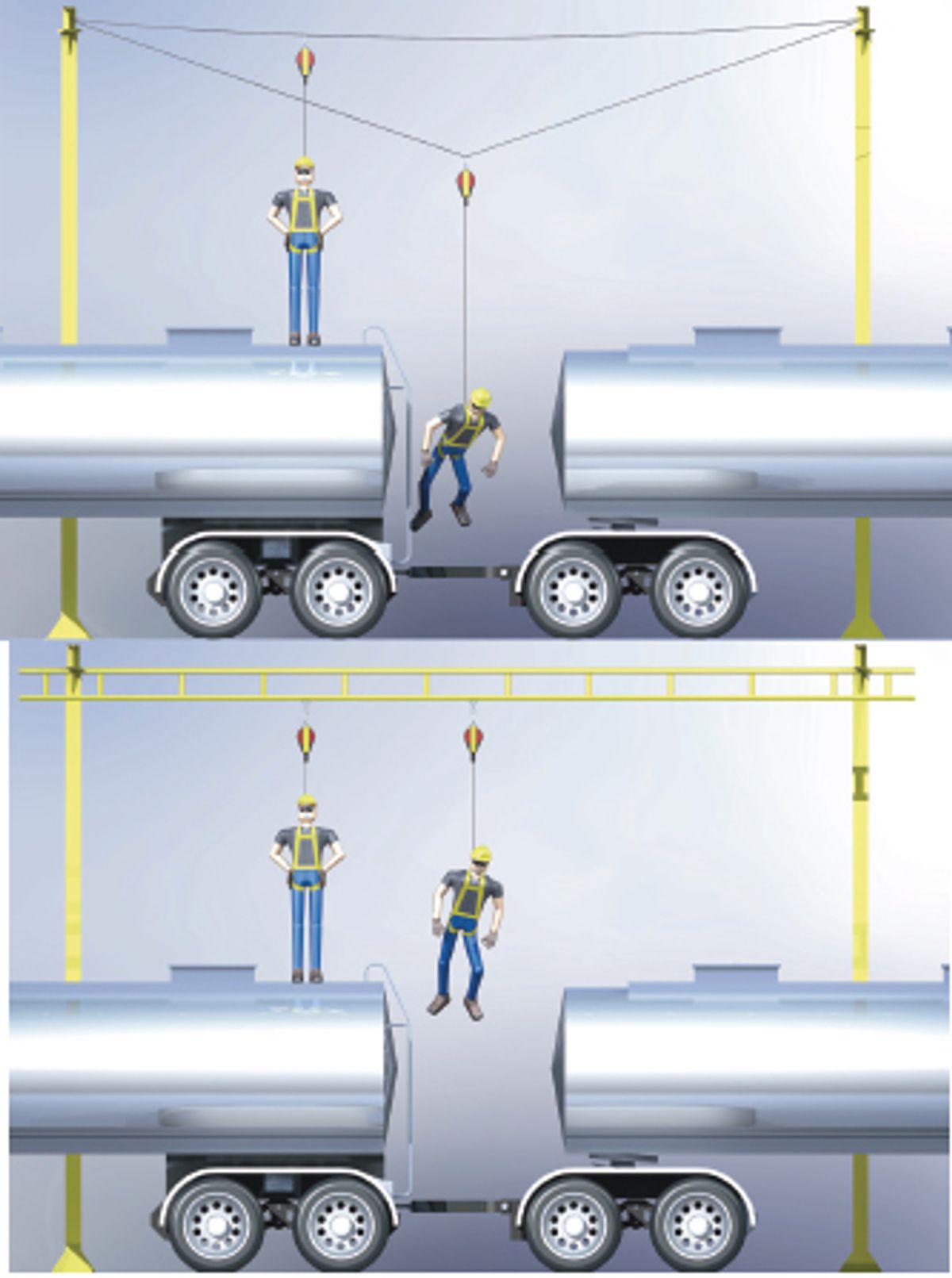
Stopping a fall from happening and containing the effects of a fall that has already started are two complementary approaches to workplace safety. NR-35 arranges them in a hierarchy (item 35.5.2): first avoid work at height, then eliminate the risk of falling, and only when that is not possible, minimize the consequences of the fall.
Confusing prevention with protection leads companies to invest only in personal equipment while leaving the underlying structure vulnerable.
What Is the Difference Between Fall Prevention and Fall Protection?
Prevention eliminates exposure to the hazard before it happens, with collective physical barriers. Protection contains the effects of a fall already under way, with personal equipment connected to guide lines. Under NR-35, collective protection comes first, and personal protection is used when collective protection is not possible or does not fully protect (item 35.6.3):
| Engineering Criterion | Prevention Measures (Passive) | Protection Measures (Active) |
|---|---|---|
| When it acts | Before the hazard materializes, eliminating exposure | After the worker loses footing, arresting the fall |
| Nature of the solution | Structural engineering and collective physical barriers | Personal protective equipment connected to guide lines |
| Practical examples | Guardrails, toe boards, walkways, and opening covers | Self-retracting lifelines, lanyards with absorbers, and harnesses |
| Priority under NR-35 | Top priority in the risk control hierarchy | Applied when collective measures do not eliminate the hazard |
| Dependence on the user | Protects passively without any action from the worker | Requires active connection and an operating procedure from the user |
What Is Fall Prevention?
Prevention covers all engineering measures that isolate the worker from the edge or drop where there is a risk of falling.
Guardrails designed to technical standards and circulation walkways provide permanent safety without requiring personal connectors during routine movement.
What Is Fall Protection?
Protection comes into play in activities where it is necessary to access the unprotected zone to carry out maintenance or assembly.
At those points, a full-body harness connected to a self-retracting lifeline or a lifeline dissipates the impact energy, protecting the worker's physical integrity.
Why One Layer Without the Other Compromises Safety
- A self-retracting lifeline in perfect condition connected to a structure with no design calculation does not protect, because the support can collapse under dynamic load.
- A walkway whose arrest points are not maintained leaves the plant unprotected, even with PPE up to date.
How Anchor Covers Both Fronts
Anchor designs and builds steel structures for collective protection and runs a maintenance center for self-retracting lifelines for personal protection, issuing technical reports and a single engineering liability record (ART).
Next Step
Now that you know the difference between fall prevention and fall protection, request a field assessment from Anchor's engineering team to identify where both layers in your plant need upgrading.